Article V requires three-quarters of the states to ratify a constitutional amendment. This work restates that rule, and every ratification since 1788, in population and in state legislators. Each result is a computation or a count from sourced records, with the analytic choices behind it stated on the methods page.
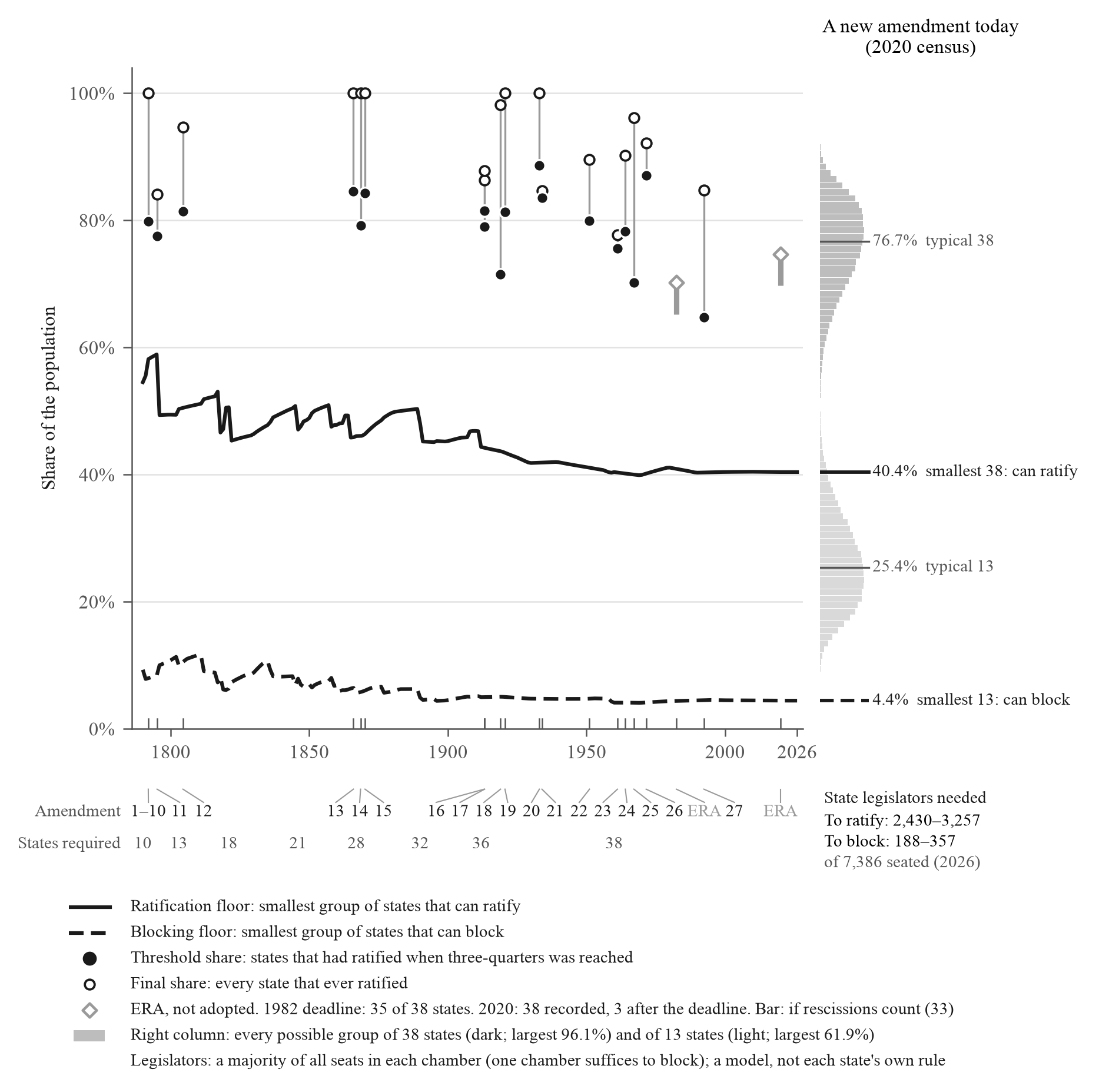
Selected results
- The ratification floor is 40.4% today, down from 54.5% in 1790. That is the population share of the smallest group of states that can ratify. Most of the decline came in steps at statehood admissions; since 1959 it has stayed between 39.9% and 41.1%.
- The blocking floor is 4.4%, the population of the 13 smallest states.
- Threshold shares averaged 79.3%, against an average ratification floor of 44.7%. A threshold share is the population share of the states that had ratified on the day an amendment reached three-quarters. Averages cover 18 ratification events: the Bill of Rights and amendments 11 through 27.
- For 7 of 18 ratification events, the decisive state's record contains no vote tally. The journals show passage by voice vote, unanimous consent, or suspension of the rules.
- These results reproduce Peter Suber's hand calculations (20 U. Mich. J.L. Reform 409 (1987)). Using his convention, this work matches 36 of his 40 published values to within 0.1 point.
The fact sheet has all results, with figures and a data table.
Status. This is a working paper. Ratification dates come mostly from secondary compilations and are being re-sourced to primary records, so results that depend on them (threshold and final shares, rejections, rescissions) are provisional. Results that depend only on census populations and admission dates (the ratification and blocking floors) are less exposed. A literature search in the proprietary legal databases is not yet complete. Details are on the methods page.
Cite
Timothy J. Miano, Article V, Measured in People (working paper, version 2026-10-03), https://articlevmeasured.pages.dev/.
Corrections
If you find an error in a record or a calculation, please reply to the launch post on Estate of Bits with the item and a source. Accepted corrections will be dated and listed here.